Smart Manufacturing Market Will Generate Record Revenue
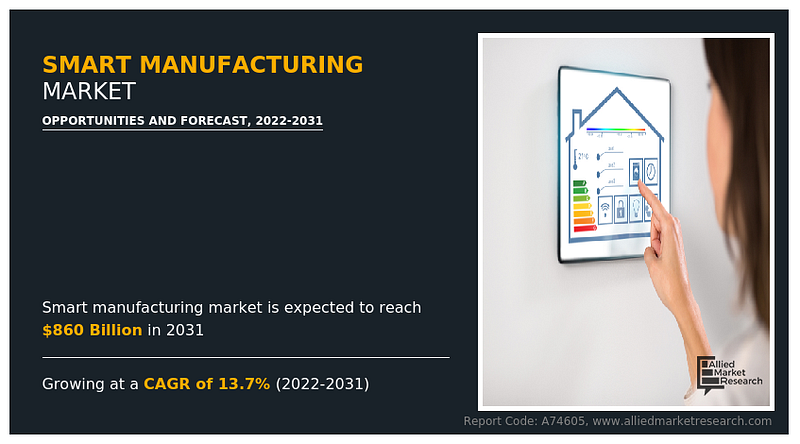
According to a new report published by Allied Market Research, titled, “Smart Manufacturing Market, by Component (Hardware, Software, Services), by Application (Machine Execution System, Programmable Logic Controller, Enterprise Resource Planning, SCADA, Discrete Control Systems, Human Machine Interface, Machine Vision, 3D Printing, Product Lifecycle Management, Plant Asset Management, Others), by End-User (Automotive, Aerospace and Defense, Chemicals and Materials, Healthcare, Industrial Equipment, Electronics, Food and Agriculture, Oil and Gas, Others): Global Opportunity Analysis and Industry Forecast, 2022–2031” The smart manufacturing market size was valued at $249.50 billion in 2021, and is estimated to reach $860 billion by 2031, growing at a CAGR of 13.7% from 2022 to 2031.
Advancements in technology, particularly in areas such as the Internet of Things (IoT), cloud computing, and big data analytics, are driving the growth of the smart manufacturing industry. These technologies enable manufacturers to collect and analyze large amounts of data in real-time, providing valuable insights and improving decision-making. The Internet of Things (IoT) involves the use of sensors and connected devices to gather data from machines, equipment, and products. This data can then be used to optimize production processes, predict maintenance needs, and improve quality control. Cloud computing allows this data to be stored and processed in a scalable and cost-effective way, enabling real-time monitoring and analysis. Big data analytics allows manufacturers to analyze large amounts of data to identify patterns and insights that can assist decision-making. This can help manufacturers to optimize production, reduce waste, and improve quality control. Machine learning and artificial intelligence can also be used to automate decision-making and improve production efficiency. Advancements in technology are also driving the development of new products and services, such as predictive maintenance and remote monitoring solutions. These solutions can help manufacturers to improve uptime, reduce downtime, and optimize maintenance schedules.
Download Sample Report: https://www.alliedmarketresearch.com/request-sample/75089
However, high costs associated with implementing smart manufacturing solutions, lack of standardization among suppliers of equipment and protocols, constant need for software updates, and limited use of technologies due to technical issues are among the major factors that will limit market growth The adoption of this technology may be significantly hampered by the substantial initial expenditure needed to deploy smart manufacturing, particularly for small and medium-sized businesses (SMEs). Smart manufacturing technology like cutting-edge sensors, robots, artificial intelligence, and machine learning algorithms can be expensive to purchase and integrate.
Smart manufacturing is revolutionizing the industrial sector by integrating cutting-edge technologies like the Internet of Things (IoT), artificial intelligence (AI), and machine learning. By identifying and fixing errors in real-time, guaranteeing uniform quality across production lines, and cutting waste, these technologies assist producers in raising the caliber of their goods. Smart Manufacturing may give manufacturers real-time insights into the manufacturing process through the use of AI and IoT, helping them to swiftly identify and fix quality concerns. In addition to boosting customer happiness by ensuring that products meet or exceed their expectations, this can result in significant cost savings by lowering the need for manual inspection and rework.
The global smart manufacturing market share is segmented based on component, application, and end-user, and region. By component, it is classified into hardware, software, and services. By application, it is classified into machine execution system, programmable logic controller, enterprise resource planning, Scada, discrete control systems, human machine interface, machine vision, 3D printing, product lifecycle management, plant asset management and others. By end-user, it is classified into automotive, aerospace & defense, chemicals & materials, healthcare, industrial equipment, electronics, food and agriculture, oil & gas, and others. By region, the market is analyzed across North America, Europe, Asia-Pacific, and LAMEA.
The key players profiled in the smart manufacturing market analysis report include ABB Ltd., Siemens, General Electric, Rockwell Automation Inc., Schneider Electric, Honeywell International Inc., Emerson Electric Co., Fanuc UK Limited, Fujitsu Global, and IBM.
Inquiry Before Buying: https://www.alliedmarketresearch.com/purchase-enquiry/75089
The report offers a comprehensive analysis of the global smart manufacturing market trends by thoroughly studying different aspects of the market including major segments, market statistics, market dynamics, regional market outlook, investment opportunities, and top players working towards the growth of the market. The report also sheds light on the present scenario and upcoming trends & developments that are contributing to the growth of the market. Moreover, restraints and challenges that hold power to obstruct the market growth are also profiled in the report along with the Porter’s five forces analysis of the market to elucidate factors such as competitive landscape, bargaining power of buyers and suppliers, threats of new players, and emergence of substitutes in the market.
Impact of Covid-19 on the Global Smart Manufacturing Industry
- COVID-19 pandemic disrupted global supply chains, leading to shortages of raw materials and components, and delays in production and delivery. This affected the ability of manufacturers to meet demand and led to increased costs.
- The pandemic created significant uncertainty for businesses, as it is difficult to predict how long the pandemic will last and what the long-term impacts will be. This has made it difficult for businesses to plan for the future and make strategic decisions.
- The outbreak led to a reduction in investment in many industries, including smart manufacturing. This has led to a slowdown in innovation and development of new technologies.
Key Findings of the Study
- Based on component, the hardware sub-segment emerged as the global leader in 2021 and software sub-segment is anticipated to be the fastest growing sub-segment during the forecast period.
- Based on application, the product lifecycle management sub-segment emerged as the global leader in 2021 and is predicted to show the fastest growth in the upcoming years.
- Based on end-user, the automotive sub-segment emerged as the global leader in 2021 and is predicted to show the fastest growth in the upcoming years.
- Based on region, the North America market registered the highest market share in 2021 and is projected to maintain the position during the smart manufacturing market forecast period.
About Us:
Allied Market Research (AMR) is a full-service market research and business-consulting wing of Allied Analytics LLP based in Portland, Oregon. Allied Market Research provides global enterprises as well as medium and small businesses with unmatched quality of “Market Research Reports Insights” and “Business Intelligence Solutions.” AMR has a targeted view to provide business insights and consulting to assist its clients to make strategic business decisions and achieve sustainable growth in their respective market domain.


Comments
Post a Comment